Countertop installation is rarely listed as a high-risk line item in a large project schedule. It tends to live near the end of the finish sequence, after cabinetry and before final inspections, treated as a routine handoff rather than a sequencing risk.
That assumption holds well enough on a small build. On projects with dozens or hundreds of units, rooms, or floors, the same workflow can quietly become one of the most disruptive parts of the closeout phase.
A Tight Critical Path
The standard workflow puts a number of dependent steps on a tight critical path. Cabinets are installed first, followed by on-site templating, factory fabrication, delivery, installation, plumbing rough-in for sinks, and any related electrical work. Each step waits on the one before it. When templating happens space by space and fabrication turnaround stretches even slightly, the install sits on a narrow window.
In a project with many similar spaces this margin disappears quickly, leaving crews scheduled to follow the countertop install idle, pushing the trades behind them out of sequence, and slipping closing or opening dates from one week into the next as the impact compounds across every space affected.
Friction in Field Fabrication
The on-site fabrication step itself introduces variables that are hard to control at scale. Each space requires individual templating, individual cutting, and individual fit adjustments. The work depends on a fabrication team executing the same precise operations across every space without quality drift.
In practice, friction accumulates in familiar ways. Cuts come back slightly off and require rework. Edges chip during transport from the workshop to the install location. Sink cutouts get measured against an outdated template revision. Seams that are lined up cleanly in templating fit unevenly once cabinetry is loaded. Each issue is minor on a single piece and significant across an entire project.
Labor scaling adds another layer. A fabricator capable of handling smaller projects well does not always scale evenly to higher volumes. Crew size, equipment capacity, and quality control systems built for one volume can stretch thin at another. Temporary labor and extended schedules become common workarounds, and consistency suffers.
Moving the Work Off-Site
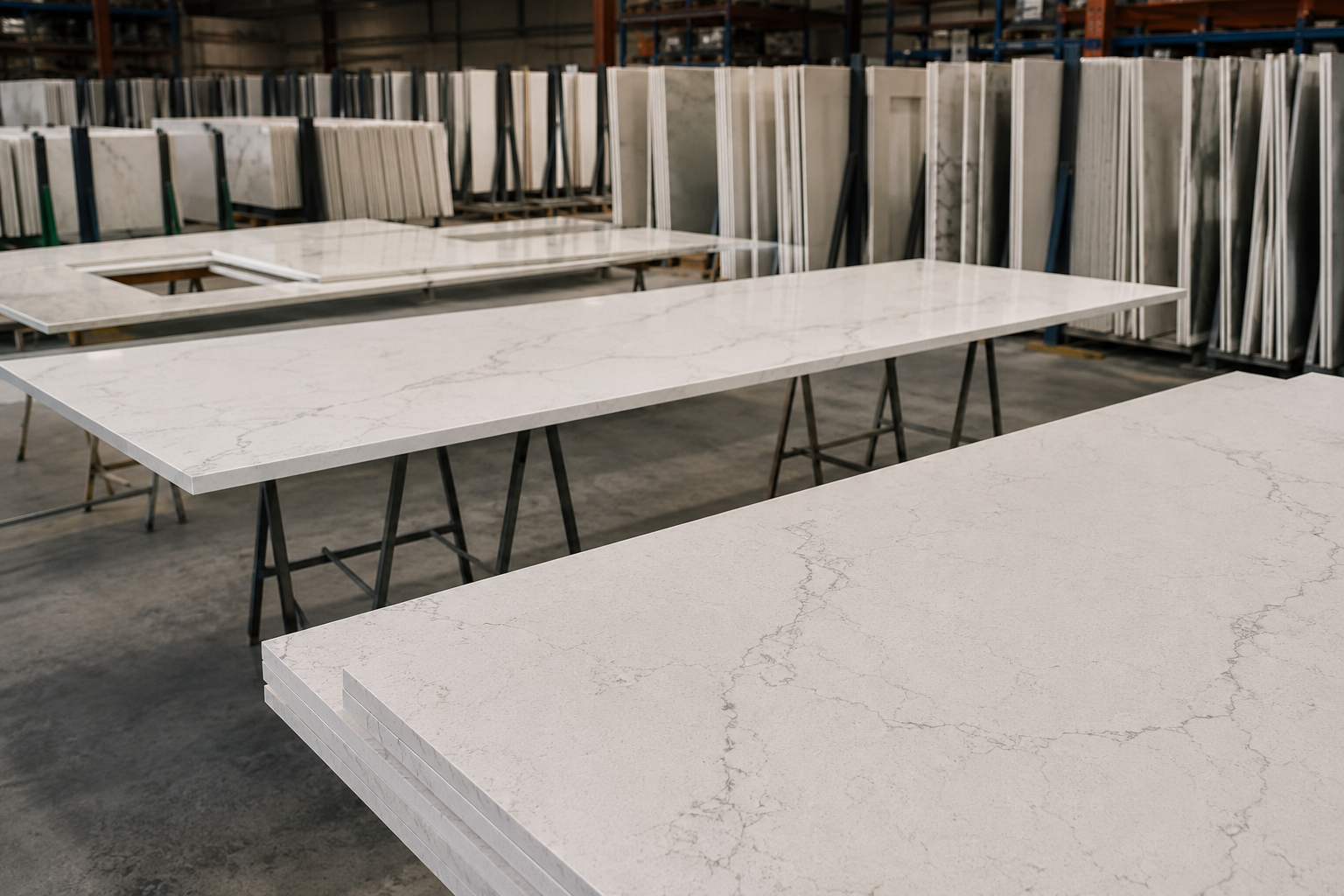
The cut-to-size approach moves the most variable parts of this workflow off the job site. Templates are derived from architectural drawings during the design phase, and slabs are cut, edged, and polished at the manufacturing facility before they ship. What arrives at the site is a finished countertop, ready to be set in place by an installation crew rather than fabricated by a field team.
Several parts of the project workflow change as a result. Fabrication time is pulled off the critical path, since cutting happens in parallel with other construction work rather than as a bottleneck near the end. Quality consistency improves, because cutting occurs in a controlled factory environment rather than in unfinished spaces with variable site conditions. Replacement orders, when needed, ship from the same production batch, so pattern and color continuity holds across the project. The on-site crew is smaller and faster, replacing fabricators with installers.
Conditions That Favor the Model
The cut-to-size model has its own requirements. Specifications must be finalized earlier in the project, field adjustments are more limited once material has been pre-cut, and the approach performs best on builds with consistent layouts and a well-coordinated design phase. For projects that meet those conditions, cut-to-size addresses one of the most persistent sources of closeout-phase delay in large-scale construction. The IndoQuartz catalog is a useful place to start for teams considering the approach.