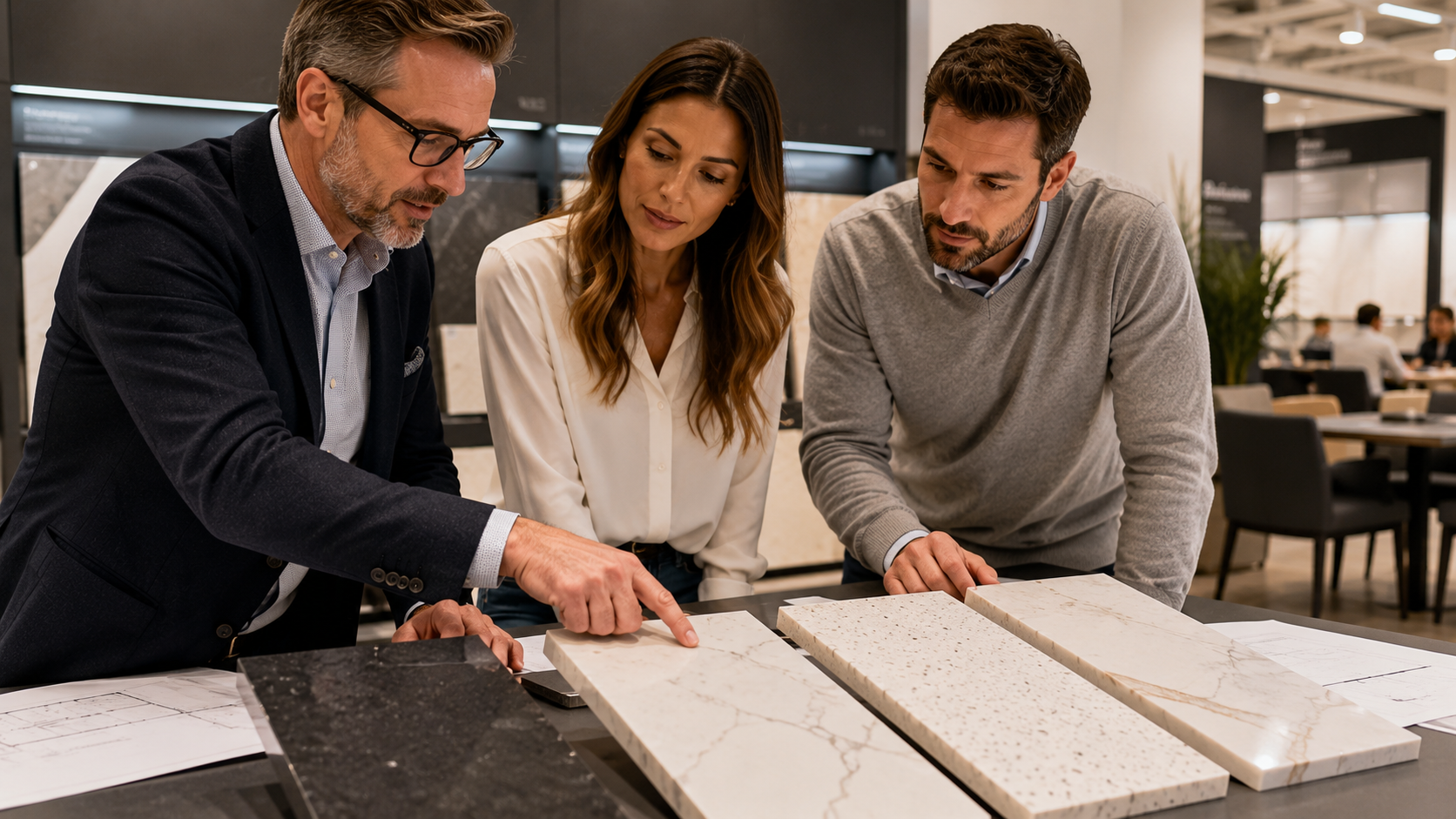
Quartz has long been associated with residential kitchens. For years, industry marketing and showroom positioning framed it as a premium home surface rather than a material suited for large-scale commercial projects.
That perception no longer reflects how quartz is used today. Across hospitality, healthcare, education, retail, and multifamily developments, quartz has become a practical commercial surface valued for its durability, hygiene standards, and long-term consistency. Project teams that still view quartz as residential-only risk overlooking significant operational and maintenance advantages.
Rethinking Surface Choices in Commercial Spaces
Surface specifications often follow familiarity instead of performance analysis. Natural stone is typically chosen for luxury spaces, laminate for cost efficiency, and quartz is still frequently reserved for residential applications. Over time, these assumptions often create avoidable maintenance and replacement costs.
The limitations become clear once the building is occupied. Marble stains easily from oils, acidic liquids, and cleaning chemicals. Laminate deteriorates quickly in high-traffic environments. Granite requires ongoing resealing and still remains porous enough to retain bacteria. While these issues may seem minor during the design phase, they often become long-term operational concerns later on.
What Commercial Projects Require
Commercial environments place far greater demands on surfaces than residential spaces do. Materials must withstand constant use while maintaining both appearance and structural performance over time.
Resistance to stains, scratches, cracks, and chemical exposure has become a baseline expectation. In healthcare, food service, and childcare settings, non-porous and food-safe surfaces also play an important role in meeting hygiene and sanitation standards.
Consistency also matters at scale. Hospitality operators and multifamily developers need uniform color, finish, and dimensions across multiple rooms and units. Unlike natural materials, engineered quartz delivers this consistency through controlled manufacturing processes.
Where Quartz Performs
As a result, quartz now extends well beyond residential kitchens. In hospitality projects, it is commonly used for reception desks, bar counters, and guestroom vanities. Healthcare facilities specify quartz for clinic counters and laboratory surfaces where cleanliness is critical. Educational and childcare spaces rely on it for hygienic, easy-to-maintain environments.
Commercial offices, retail stores, and multifamily developments also continue adopting quartz for its durability, low maintenance requirements, and consistent finish quality across large-scale installations. For commercial projects that demand durability, consistency, and low maintenance at scale, Indoquartz is built to perform from installation to long-term daily use.